
What can braces help with?
There are many different bite problems that can affect the way you breathe, speak, and eat. If your teeth are uneven and the upper and lower jaws don’t come together correctly, this can negatively impact your daily life – causing discomfort or even severe pain.
These problems typically begin to develop when adult teeth start growing in, which is why children often need braces to redirect their teeth and correct their bite while their jaws are still growing. If misalignments are left untreated, they will only get worse with age.
That’s why it’s never too late to seek orthodontic treatment like braces in London. No matter your age, if you are experiencing orthodontic issues, we can help you at Finsbury Dental Care.
At our dental clinic near Finsbury Circus, we use orthodontic braces to treat a variety of ‘bad bites’ – known as malocclusions. These include:
- Crooked teeth – twisted or overlapping teeth due to overcrowding
- Gapped teeth – incorrectly spaced teeth with gaps between them
- Crossbite – upper and lower teeth overlapping in different places
- Overbite – upper jaw protruding significantly over the lower jaw
- Underbite – lower jaw protruding significantly beyond the upper jaw
- Open bite – upper and lower teeth don’t meet with a gap in the middle

The majority of malocclusions have genetic causes, but they can be influenced by environmental factors, often causing pain and low self-esteem.
Our orthodontic appliances can help to give you a healthy bite and confidence boost with a straightened smile. There are several options available when it comes to braces, but the right one for you will depend on your unique bite.
Keep reading to learn more about the different types of braces we offer, then contact us to book an orthodontic consultation at Finsbury Dental Care.
Metal vs Ceramic Braces in London
Traditional fixed braces work by bonding metal brackets to the front of your teeth and running a metal wire through them. This wire is tightened to put pressure on your teeth and slowly move them into a new position, sometimes with extra help from rubber bands.
This is a pretty much universal orthodontic treatment, as it can be used to correct even severe and complex malocclusions as well as moderate misalignment.
Wearing fixed braces comes with requirements like adjusting your diet to eliminate sticky, hard, and crunchy foods, improving your oral hygiene with special orthodontic brushes, and visiting your orthodontist in London for check-ups every 6 weeks.
The main concern that people have with fixed metal braces is that they are very visible, as there is no hiding them when you’re speaking, smiling, or eating.
However, with modern advances in orthodontic care, there are now more discreet braces available. These include ceramic braces, which have tooth-coloured brackets, and clear braces, which have see-through brackets made from crystalline material.
These are both much more aesthetically pleasing than the stereotypical ‘train track’ look that many patients feel self-conscious about, as they are less noticeable in person and in pictures – and the brackets are often smaller and more comfortable, too.
Get in touch for an orthodontic assessment to learn more about our fixed braces, including ceramic braces and braces with clear brackets.
Lingual Braces in London
Some patients have bite problems that can only be treated with fixed braces, but they would not be happy with having visible braces on the front of their teeth.
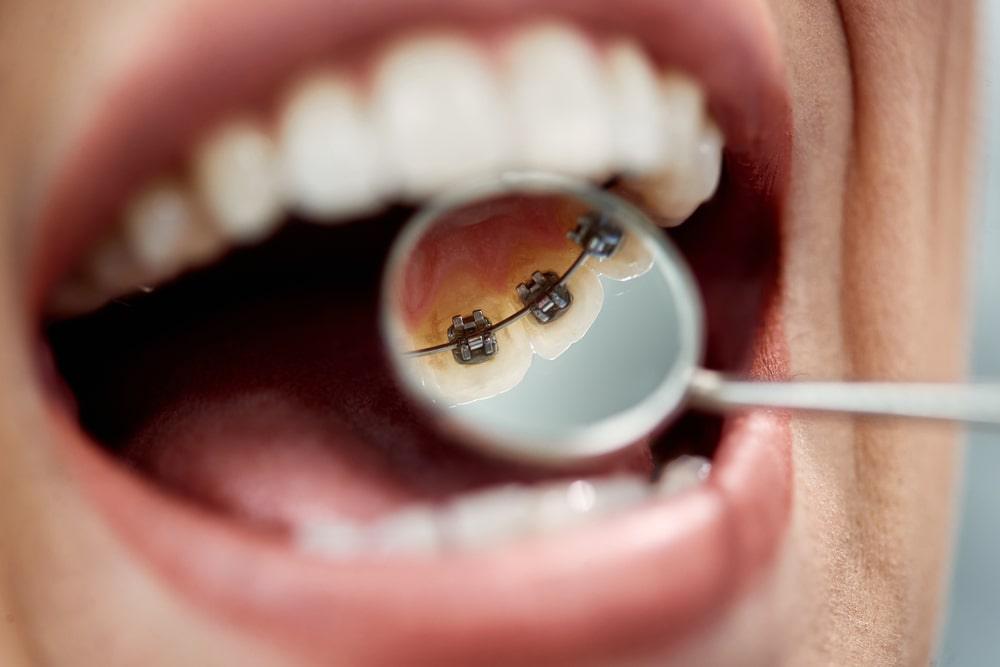
That’s where lingual braces come in as an ‘invisible’ alternative to traditional front-fixed braces. As the name ‘lingual’ suggests, the brackets are attached on the side of the teeth facing the tongue instead, meaning they can’t be seen directly from the front.
With the brackets and archwire concealed on the back side of the teeth, lingual braces allow you to straighten your teeth and align your bite more discreetly.
As they require a high level of customisation to fit the contours on the back of each tooth, lingual braces usually cost more than braces fixed on the front of the teeth. However, in many cases, this precision can lead to repositioning teeth faster.
As with their front-fixed counterparts, wearing lingual braces means maintaining certain dietary limitations and working harder to keep your teeth clean. Brushing and flossing around them can be difficult because you can’t see them as well.
Additionally, it can take a little longer to get used to wearing braces on the back of your teeth, as you have to adapt your tongue placement around them, which can cause a temporary lisp.
Though lingual braces come with a lot of adjustments, their hidden design – plus avoidance of the discolouration that can sometimes occur with brackets bonded to the front teeth – make braces behind the teeth worth it.
Invisalign Braces in London
Another version of ‘invisible’ braces – which aren’t really braces at all – is the popular Invisalign treatment. This is especially preferred by adults looking to straighten moderately crooked or gapped teeth without obvious metalwork.
Rather than brackets and wires, Invisalign uses clear aligners that look like retainers. Made from a strong yet flexible plastic, the aligners are moulded to fit your teeth and can be taken out for eating and cleaning, making them far more discreet and convenient than traditional braces.
This orthodontic treatment involves wearing transparent aligners for 20-22 hours a day, swapping to a new set of aligners every few weeks to gradually push teeth into the proper alignment. The whole process can take anywhere from 3 months to 2 years.
As with any orthodontic procedure, how long it takes for Invisalign to straighten your teeth will depend on the type and severity of your dental misalignment.
Invisalign is suitable for a range of mild and moderate bite concerns, but in more severe cases, fixed braces may be more efficient and affordable – which is why it’s best to have a consultation at our clinic to discuss the most suitable option for your bite.
If you’re a good candidate for Invisalign, you can benefit from removable aligners that allow you to eat and drink whatever you like, as long as you clean your teeth before you put them back in.
Being far more discreet and comfortable than traditional braces, it’s understandable why so many orthodontic patients are interested in Invisalign in London.
How much do braces in London cost?
The cost of braces in London depends on the type of braces you choose, but not all options may be available to you. This will depend on the recommendations of the orthodontist who examines your bite and determines the most effective method of moving your teeth.
When you come to Finsbury Dental Care for a braces consultation, we can identify your malocclusion and the best method to correct it. Of course, we will discuss all of the possibilities with you, taking your needs and budget into account when agreeing on a treatment plan.
We offer competitive fees and transparent pricing so you understand the cost of braces in London, with an exclusive Invisalign Go package available at a discounted price.
To make orthodontic treatment more accessible, we also offer dental finance for braces in London, allowing eligible patients to spread the cost of their braces with monthly payments.
For Braces in London, get in touch with our expert team today
We understand how daunting orthodontic procedures and the associated costs can be, but our experienced team and the range of payment options at Finsbury Dental Care make the process of straightening your teeth as easy as possible.
To learn more about braces and aligners and which might suit your needs best, contact our practice to set up a consultation. Call 020 7638 6556 or send an email to [email protected] and our team will be happy to help!
